

The Tesla Cybertruck, Tesla’s first vehicle to fully utilize its larger 4680-format cell, has been out for about a month now. But with only limited quantities on the road in the public’s hands, there have still been a lot of questions about the vehicle.
Now we’ve got an answer to one of the most important questions: charge rate. It’s not great – but that might not be the whole story.
Peak charging speed, measured in kilowatts or kW, is one of the most important stats on an EV – arguably much more important than range. The higher the charge rate the quicker you can get back on the road during a charging session. Older EVs have DC charge rates around 50kW, which is quite slow compared to today’s standards, where EVs are usually capable of 150kW+, with some models capable of up to 350kW. Tesla’s V3 superchargers can deliver up to 250kW of power, which is plenty fast, though the new V4s are even faster at 350kW.
But another important aspect of charging is charge curve, or how quickly a vehicle “tapers” off of the peak charge rate to a lower one. EVs can’t sustain peak charge rates forever, so will usually only hold on to the peak rate for a certain period of time before lowering to a slower rate. This is why EVs usually state their DC charge time “to 80%,” because charging past 80% at a high rate is generally bad for battery durability.
Until now, this was an open question for the Cybertruck, especially since it is Tesla’s first car to fully utilize the 4680-format cells which have been noted to have somewhat worse charging performance than the previous 2170 format cells.
Video of Cybertruck’s charging curve
But in a video posted by Our Cyber Life, a new youtube channel formed by a couple who took delivery of their Cybertruck two weeks ago, we now know what the Cybertruck’s charge curve looks like. The channel’s videos so far have fully focused on the Cybertruck ownership experience, from a couple who have never owned a Tesla before (but one of them, nevertheless, seems to be a Tesla employee – which explains the early Cybertruck delivery).
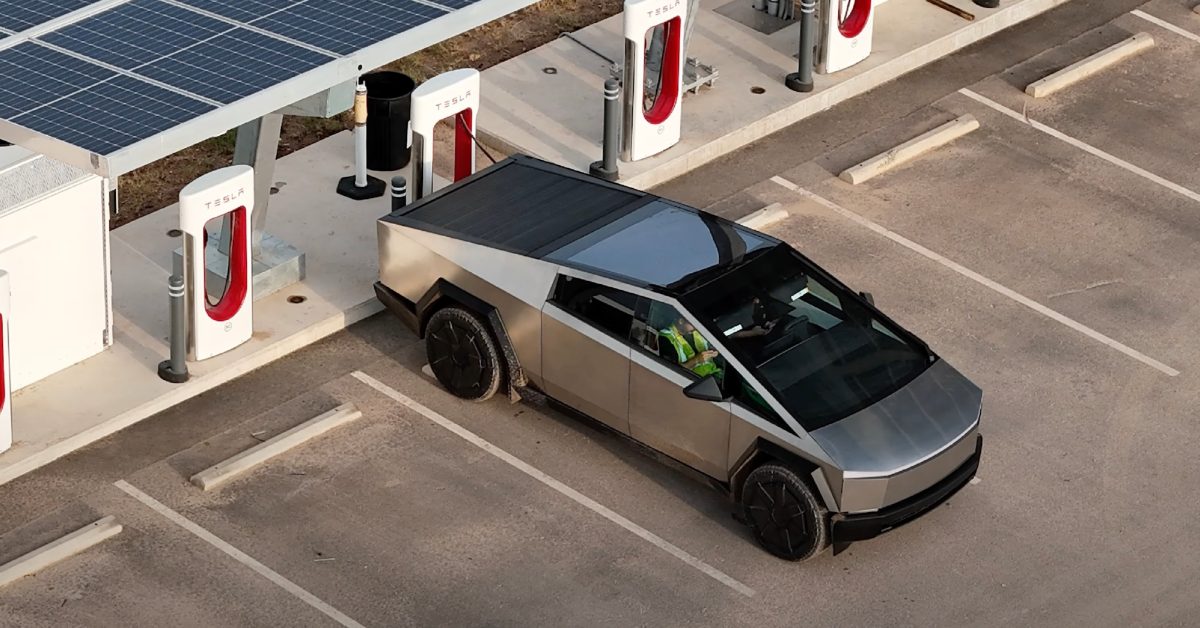
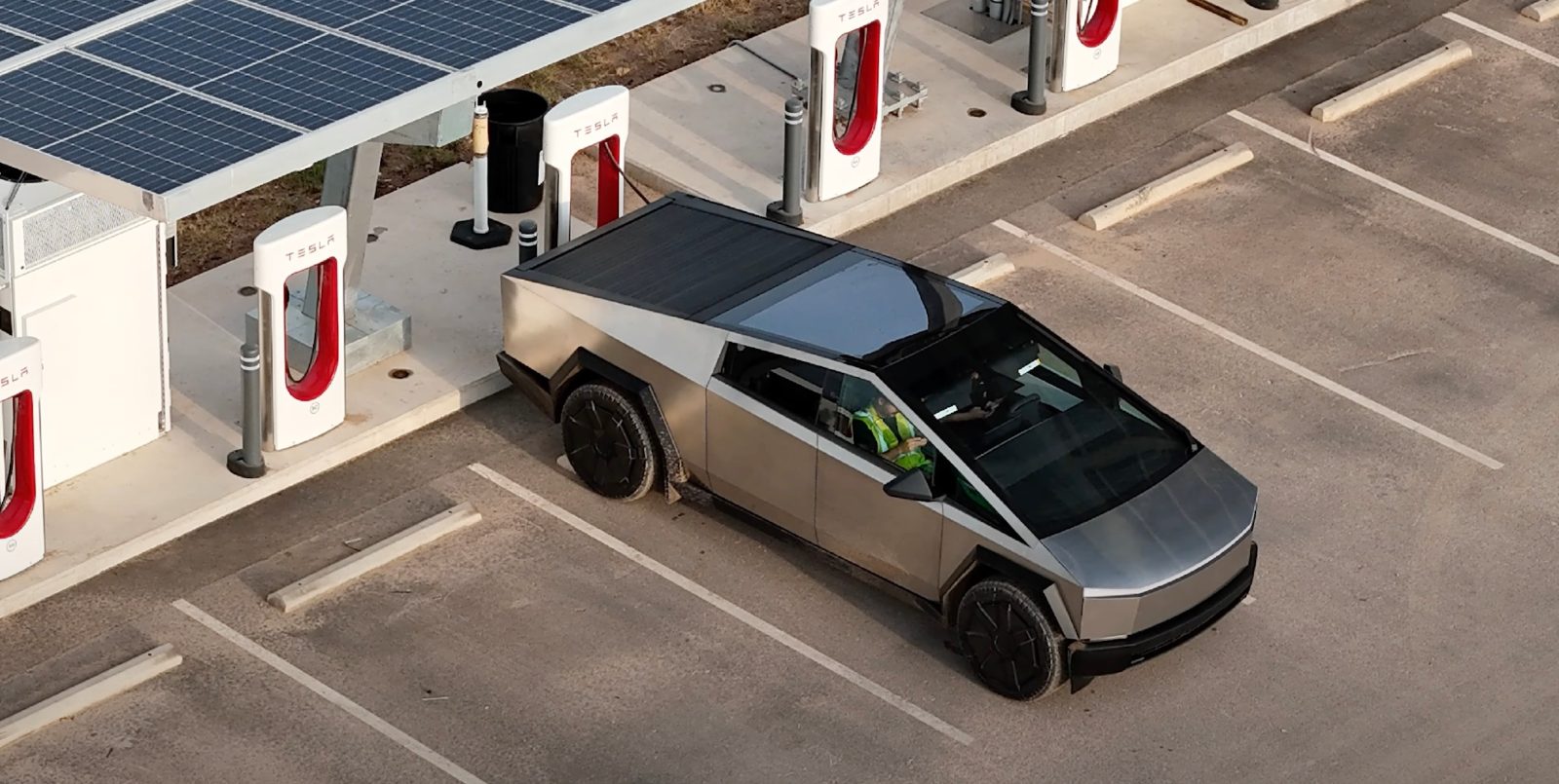
The video fully documents a Cybertruck charge at the Tesla supercharger in Mesa, Arizona, a V3 Supercharger capable of 250kW peak power delivery. Most of the video is just a 5x speed timelapse of the screen during the charging session, though Our Cyber Life helpfully included graphs showing charge rate for those who are “not interested in watching paint dry.”
As we can see in the video and accompanying graphs, the Cybertruck seems to have a relatively poor charge curve, at least for this charging session at a busy V3 Supercharger. The car starts at 14% state of charge, after about 20 minutes of preconditioning (an automatic process to raise battery temperature to accept higher charge rates).
It immediately jumps to a peak charge rate of 255kW, but starts to taper quite rapidly, with charge rate gradually decreasing starting at 20% SOC. By 40% SOC the car is down to 150kW, 100kW at 60% SOC, and reaches a plateau of 75-80kW at about 66% SOC, which it holds until around 90% – when the Youtuber’s camera died and the Cybertruck headed out.
All in all, it was a 50 minute charge session from 14-90%, adding 94kWh worth of energy into the Cybertruck’s 123kWh battery. Or, using the standard 80% cutoff, 14-80% took 40 minutes.
Brief comparison with other vehicles
Tesla vehicles do tend to taper rather early, but make up for it with high peak charge rates. It’s usually better to do more frequent, shorter charge sessions to take advantage of higher charge rates at low SOC, rather than to charge all the way up to 90 or 100%. Plus, busy Superchargers will penalize you for sticking around too long while others are waiting for a charge.
This is still a reasonably quick charge rate, especially when compared to the early days of EV charging or compared to AC charge times which run in the hours, not minutes.
But given the Cybertruck’s huge 123kWh battery, we expected quicker charging than this. A larger battery can usually sustain a higher charge rate for longer (this concept is known as “C-rate,” or charge rate divided by total capacity). A Model 3 Long Range has a peak C-rate of 3 and average C-rate of 1.4 when charging from 0-100%, but in this test, the Cybertruck showed a peak C-rate of just over 2 and average of about .9.
Measured in “miles of charge added per minute,” which is an even more important metric for practical driving purposes, the picture gets somewhat worse for the Cybertruck. The Model 3 is rated at 333 miles of range, and from 14-80% can add about 220 miles of range in 31 minutes. By the same metric, from 14-80%, the Cybertruck added 206 miles in 40 minutes – less range in a longer period of time.
All of these are significantly slower than the current charging champions, the Hyundai Ioniq 5 and its cousin the Kia EV6, which despite a slightly lower peak charge rate of around 230kW, have an impressively broad charging curve that can sustain speeds of 170-180kW all the way up to 70-80%.
And compared to a similar-ish vehicle, the Rivian R1T, the R1T tapers a little bit later, but not by a tremendous amount. The R1T wins here, but by a small margin (a margin which becomes larger when taking into account Rivian’s higher efficiency and Tesla’s traditional, uh, “optimistic” range estimates).
But that’s not the whole story
However, we need to caution that this is only one test in one set of circumstances – and the circumstances are less than ideal for the Cybertruck in question.
First, the Cybertruck’s charging system is built with the ability to switch between 800-volt and 400-volt charging. V3 Superchargers are 400V, so it’s possible that the Cybertruck will be able to charge better from an 800V charger – if Tesla gets around to installing them. The V4 Supercharger is supposed to be capable of 800V charging, but so far we’ve only seen 400V installs, showing how Tesla’s charging network isn’t ready for Cybertruck – and that’s true in more ways than one.
Second, it was a busy Supercharger, and on busy Superchargers sometimes Tesla limits charging speed. A Supercharger station won’t necessarily be built with the ability to give maximum 250kW power to every stall at the same time, because you’re rarely going to have every stall full with a car at 0% SOC calling for maximum charge rate. So a 10-stall, 250kW charger might have a total 1-1.5MW capacity, instead of the 2.5MW you’d expect from the nameplate 250kW charge rate. It is possible the Cybertruck was given max charge rate at low SOC, and then the station itself tapered off power delivery in order to prioritize lower-SOC vehicles at the station.
Finally, this is a brand-new vehicle and Tesla may be waiting for more data on battery health while charging, in order to potentially increase charge rates in the future. Tesla is fond of offering over-the-air updates to improve vehicle capabilities, and to allow early owners to act as beta testers. In this case, the owner in question is also a Tesla employee, and Tesla is even more willing to use employees as guinea pigs on new vehicles. So it’s entirely possible that charge rates might increase in a future software update – as happened with Rivian as well.
FTC: We use income earning auto affiliate links. More.
